
Importance and Types of Monitoring in Excavation Projects
Monitoring in excavation—especially in deep excavations using retaining systems such as nailing, soldier piles, or Top-Down methods—plays a critical role in ensuring the stability and safety of surrounding structures. The collection of precise measurements using geodetic and geotechnical instruments to monitor displacements and behavior is known as micro-geodesy.
Why Monitoring Is Essential in Excavation?
Large and sensitive structures such as dams, power plants, towers, and deep excavations require continuous monitoring to prevent instability. Monitoring typically falls into two main categories:
-
Geotechnical Monitoring (e.g., inclinometers, piezometers, load cells)
-
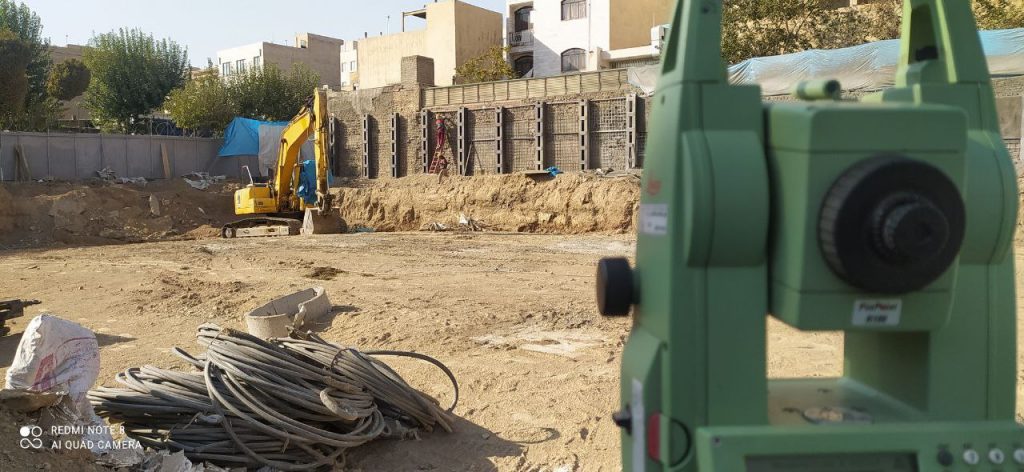
Geodetic Monitoring (e.g., total stations, GPS-based deformation tracking)
In modern engineering, no major project is considered safe without a robust monitoring system. In countries like Iran, all large dams and excavation projects are now equipped with instrumentation and geodetic observation systems to ensure structural integrity.
How Does Geodetic Monitoring Work?
Geodetic monitoring involves establishing a network of control points on and around the structure. At scheduled intervals, engineers use precise instruments (total stations, GPS, etc.) to monitor:
-
Distances
-
Angles
-
Coordinates
These observations allow engineers to detect even small displacements and potential deformation in the structure or soil.
Role of GPS in Structural Monitoring
The role of multi-antenna GPS systems has grown significantly in recent years. They enable:
-
Real-time and continuous monitoring
-
Accurate angular behavior tracking
-
Automated alerts for displacement
This level of precision and automation makes GPS an essential tool in modern structural health monitoring.
How Is the Behavior Interpreted?
Geodetic monitoring results typically provide displacement vectors. Engineers then analyze these vectors to determine structural performance. This process requires both technical expertise and field experience to interpret complex movements accurately.
Why Behavior Monitoring Is Crucial?
Due to the uncertainty in geomechanical parameters and the unpredictable nature of geological formations, it is nearly impossible to determine the true safety factor of an excavation or dam with full certainty. Thus, real-time behavior monitoring is essential to:
-
Prevent sudden failure
-
Predict instability
-
Take corrective action in time
Economic and Social Importance of Excavation Monitoring
Excavation and dam projects are high-risk and high-cost operations. Failure can result in:
-
Human casualties
-
Damage to infrastructure
-
Legal and political consequences
Monitoring helps detect early warning signs and implement preventive measures, minimizing damage and protecting both lives and investments.
Conclusion
The integration of instrumentation, data interpretation, and back-analysis of results allows engineers to identify potential threats early. Continuous monitoring ensures the project remains safe throughout the design, construction, and operational stages.
