
Back Anchoring Systems and Nailing in Excavation Support
Unprincipled excavation can lead to wall collapse or damage to adjacent buildings. To prevent this, temporary support structures known as “retaining systems” are used. Two common types are the tieback (back anchoring) and nailing systems, which we will explore here.
What Is the Tieback System?
The tieback (or soil anchoring) system involves sequential excavation. Typically, 2 to 3 meters of soil is removed, followed by horizontal boreholes into the excavation wall. Cables are inserted into the holes and grouted to bond with the soil. These cables are then tensioned using hydraulic jacks and anchored at their ends.
After grouting, the boreholes are filled with concrete. Once hardened, the jacks are released, increasing the cable’s prestress and reducing earth pressure. This process is repeated at deeper levels as necessary.
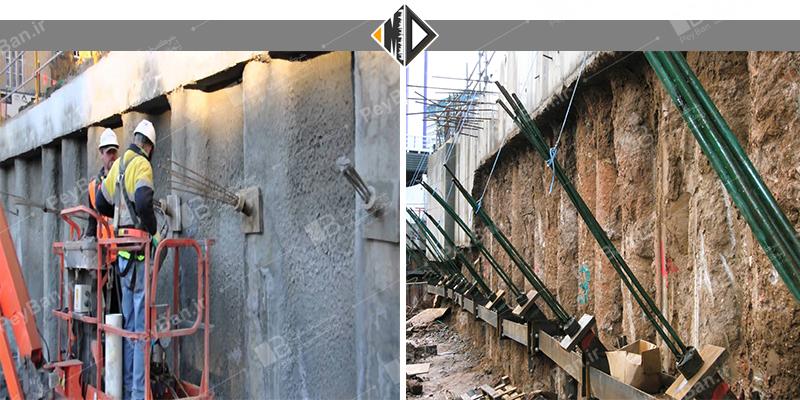
Advantages of Tieback Systems
-
Better wall deformation control compared to nailing
-
Improved mechanical behavior of soil due to grout injection
-
Higher safety and reliability
-
Space-saving retaining structure within the excavation
-
Effective lateral earth pressure reduction
-
Ability to stabilize walls using surrounding soil
Disadvantages of Tieback Systems
-
Requires skilled labor and specific equipment
-
Time-consuming without proper management
-
Higher execution cost
What Is the Nailing System?
Nailing begins by excavating 1–2 meters, followed by horizontal boreholes with diameters of 5–10 cm. Steel bars are inserted and grouted to enhance bond strength and reduce corrosion. A final surface layer is then applied—either shotcrete, cast-in-place concrete, or prefabricated panels.
The final facing can be temporary (to prevent weathering and maintain wall support) or permanent (installed after nut-tightening).
Advantages of Nailing
-
Can address obstacles encountered in boreholes
-
Ideal for tight-access areas
-
Reduces noise and is environmentally friendly
-
Lower cost, labor, and construction time
-
Flexible and fast to implement
-
Requires fewer materials
Disadvantages of Nailing
-
Not suitable near water tables or sensitive soils
-
Risk of steel nail abrasion
-
Requires skilled workers
Tieback vs. Nailing: Key Differences
-
Nailing is generally more cost-effective
-
Offers more space for machinery movement
-
Less reinforcement is required in nailing
-
Nailing uses fewer specialized tools
-
In nailing, bars activate post-deformation
-
In tiebacks, prestressed tendons proactively stabilize the soil
Conclusion
Tieback and nailing are both effective methods for excavation support. Before implementation, soil properties, groundwater presence, and obstacles must be assessed. The final choice depends on budget, timeframe, and site-specific conditions.
Back Anchoring Systems and Nailing in Excavation Support
Unprincipled excavation can lead to wall collapse or damage to adjacent buildings. To prevent this, temporary support structures known as “retaining systems” are used. Two common types are the tieback (back anchoring) and nailing systems, which we will explore here.
What Is the Tieback System?
The tieback (or soil anchoring) system involves sequential excavation. Typically, 2 to 3 meters of soil is removed, followed by horizontal boreholes into the excavation wall. Cables are inserted into the holes and grouted to bond with the soil. These cables are then tensioned using hydraulic jacks and anchored at their ends.
After grouting, the boreholes are filled with concrete. Once hardened, the jacks are released, increasing the cable’s prestress and reducing earth pressure. This process is repeated at deeper levels as necessary.
Advantages of Tieback Systems
-
Better wall deformation control compared to nailing
-
Improved mechanical behavior of soil due to grout injection
-
Higher safety and reliability
-
Space-saving retaining structure within the excavation
-
Effective lateral earth pressure reduction
-
Ability to stabilize walls using surrounding soil
Disadvantages of Tieback Systems
-
Requires skilled labor and specific equipment
-
Time-consuming without proper management
-
Higher execution cost
What Is the Nailing System?
Nailing begins by excavating 1–2 meters, followed by horizontal boreholes with diameters of 5–10 cm. Steel bars are inserted and grouted to enhance bond strength and reduce corrosion. A final surface layer is then applied—either shotcrete, cast-in-place concrete, or prefabricated panels.
The final facing can be temporary (to prevent weathering and maintain wall support) or permanent (installed after nut-tightening).
Advantages of Nailing
-
Can address obstacles encountered in boreholes
-
Ideal for tight-access areas
-
Reduces noise and is environmentally friendly
-
Lower cost, labor, and construction time
-
Flexible and fast to implement
-
Requires fewer materials
Disadvantages of Nailing
-
Not suitable near water tables or sensitive soils
-
Risk of steel nail abrasion
-
Requires skilled workers

Tieback vs. Nailing: Key Differences
-
Nailing is generally more cost-effective
-
Offers more space for machinery movement
-
Less reinforcement is required in nailing
-
Nailing uses fewer specialized tools
-
In nailing, bars activate post-deformation
-
In tiebacks, prestressed tendons proactively stabilize the soil
Conclusion
Tieback and nailing are both effective methods for excavation support. Before implementation, soil properties, groundwater presence, and obstacles must be assessed. The final choice depends on budget, timeframe, and site-specific conditions.
