
Soft Clay Ground Improvement Using Rigid Inclusions: A Case Study in Durban, South Africa
Introduction
Construction on soft clay soils presents persistent challenges due to their low strength, low stiffness, and low permeability. These characteristics often lead to problems such as limited bearing capacity and long-term settlement, especially if foundation design is inadequate. In Durban, South Africa, soft clay extends to depths of up to 35 meters, making conventional deep foundation solutions such as driven piles economically unfeasible.
This case study examines the application of rigid inclusions (RIs) for ground improvement at the Clairwood Logistics Park, built on the site of the former Clairwood racecourse. The project includes multiple warehouses, requiring a cost-effective and settlement-sensitive foundation solution. The selected approach integrated pre-construction testing, real-time settlement monitoring, and strict quality control.
Project Overview
Site Challenges:
-
Soft clay layers up to 35 m deep
-
Strict differential settlement criteria
-
Cost constraints for industrial-scale construction
Ground Improvement Solution:
-
Rigid inclusions (diameter: 350 mm) installed across the site
-
Load transferred through a load transfer platform
-
Settlement monitored using surveying tools and vibrating wire sensors
Key Findings
1. Settlement Performance
-
Monitoring of the platform’s performance showed settlements within acceptable limits.
-
Most observed settlements were less than 5 mm, meeting design requirements.
2. Load Capacity
-
Creep load testing revealed that each rigid inclusion could sustain a vertical load of 500–750 kN with minimal settlement.
-
This performance confirmed the efficacy of the method for supporting warehouse loads.
3. Innovation in South Africa
-
This project represents a novel application of rigid inclusions in South African geotechnics.
-
The solution combined economic efficiency with technical reliability.
4. Back-Analysis and Optimization
-
Field test back-analysis refined design parameters.
-
Helped accurately capture soil behavior and inclusion performance for future optimization.
Conclusion
The use of rigid inclusions in Durban’s soft clay soils provided a cost-effective and technically sound alternative to conventional piling systems. The method enabled settlement control and high load-bearing capacity, making it a valuable ground improvement technique for similar soil conditions in South Africa and beyond.
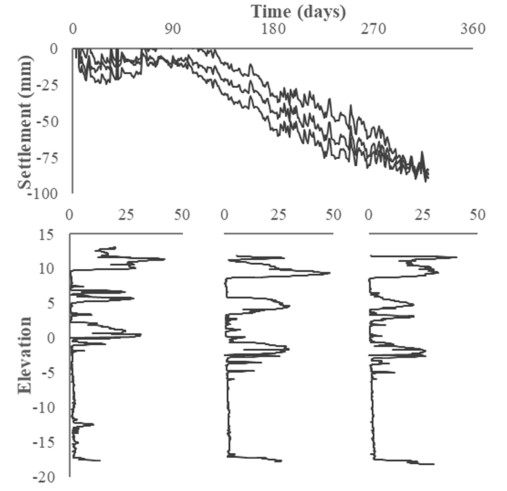
Figure 1:
Measured settlement performance on Platform 1.
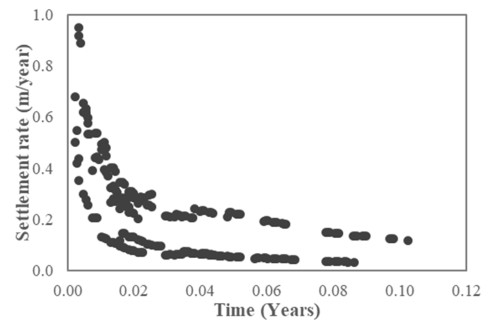
Figure 2:
Settlement rate of installed rigid inclusions.
