
Retaining Systems: Types and Applications
Before diving into retaining systems, it’s essential to understand their purpose. Retaining structures are used to counteract forces on building walls, prevent collapse and settlement, and improve overall structural stability.
Types of Retaining Systems
Retaining systems come in various forms including diaphragm walls, cross-lot bracing, truss systems, anchors, sheet piles, cast-in-place piles, and soil nailing. Despite their structural differences, all serve the same fundamental function: supporting excavation and protecting adjacent structures.
Truss Retaining System
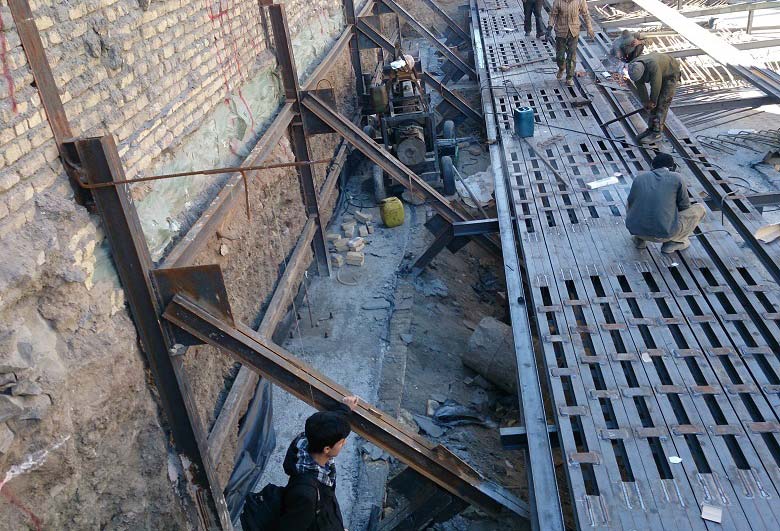
One of the most common systems is the truss method, suitable for shallow excavations. Boreholes are drilled at specific intervals, typically one meter below the main foundation level. Borehole depth is influenced by excavation depth, soil type, and surcharge load. After reinforcement, IPE profiles are inserted and filled with concrete.
If gaps form where the retaining system meets adjacent structures, they are filled with materials. Adjacent soil is removed to allow proper installation of inclined members, which are then welded to vertical profiles and anchored to isolated footings.
Diaphragm Walls
This method involves three steps: borehole excavation, prefabricated reinforcement installation, and concrete casting. Diaphragm walls are known for their high safety and fast execution, making them ideal for deep excavations. However, due to their high cost and the need for skilled labor, they are less commonly used.
Tieback Systems (Anchors)
Also known as anchorage systems, these are used to stabilize excavation walls using soil nails or tiebacks. This method involves injecting cement grout into boreholes, gradually reducing the water-to-cement ratio from 1.5 to 0.5 to fill soil voids and strengthen the bond.
Tension is applied using hydraulic jacks, and once the grout hardens, the cables maintain the prestress. The anchored soil mass acts as the retaining structure, transferring earth pressure away from the wall.
Sheet Pile Systems
This method uses steel or timber piles, with timber commonly used in firm soils. A key advantage is the reusability of piles, reducing material requirements. It occupies minimal space and offers rapid installation, even in water-prone areas.
Drawbacks: High noise levels, difficulty in hard soils, and the need for skilled labor and advanced machinery.
Cast-in-Place Pile Systems
Cast-in-place piles are ideal for soft soils. Common materials include steel, concrete, and wood—of which concrete piles are the most widely used due to their affordability and versatility.
Pros: Low cost, fast execution, suitable for excavations up to 5 meters, and can serve as permanent or temporary retaining systems.
Cons: Not suitable for urban projects or deep excavations without additional piles.
Cross-Lot Bracing
Shallow boreholes (25–35 cm) are drilled next to the excavation. H- and I-shaped beams are installed in the holes. Excavation then proceeds, and wooden planks between the vertical profiles prevent soil collapse. This method combines features of both truss and sheet pile systems.
Pros: Minimal risk of machine interference due to the wide area occupied.
Cons: Bracing is complex in deep holes (over 10 meters), requiring alternative solutions for weak soils.

Conclusion
As covered in this article, each retaining system has distinct advantages and limitations. Excavation requires precision and adaptability. Though structural forms vary, all systems share the same core function. Common retaining methods include soil nailing, diaphragm walls, tiebacks, trusses, pile driving, and cross-lot bracing.
We hope this article was informative and answered your questions about retaining systems.
