
Optimal Nail Angle for Soil Nailing in Slope Stabilization
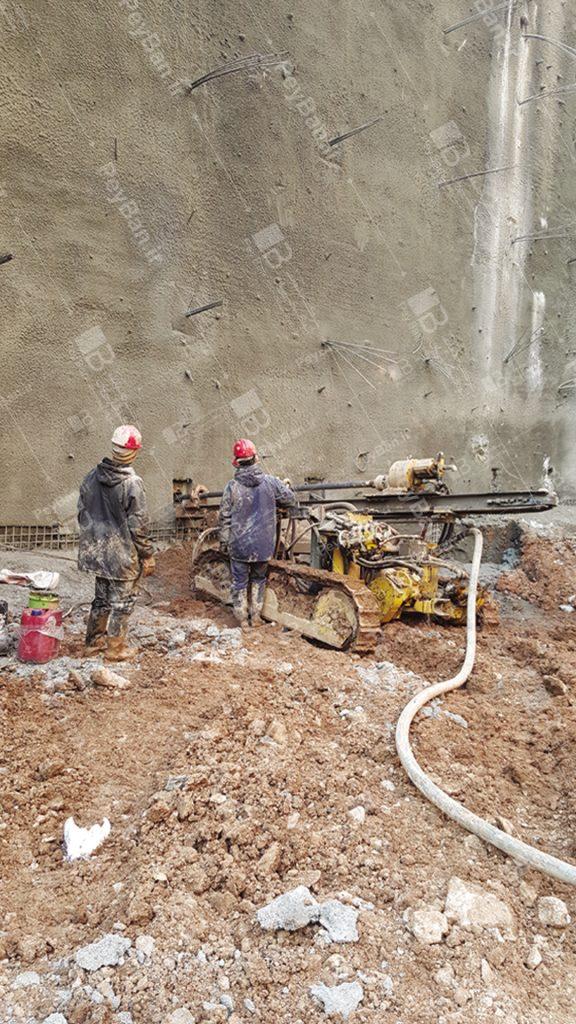
The performance of nailed slopes (soil nailing) in excavation stabilization is assessed by their stability and deformation. Deformations of nailed slopes can affect adjacent structures, utilities, and roads. The extent of damage depends on the magnitude and pattern of soil deformation around the nailed slopes.
Stability and deformation depend on many factors, and predicting the deformation amount is complex and time-consuming. Therefore, researchers seek simpler and more accurate methods to predict deformation in nailed slope stabilization.
Advantages of Soil Nailing
Soil nailing offers significant benefits compared to conventional retaining methods, such as lower cost and increased demand among engineers.
Analysis Method
Finite element analysis using the Mohr-Coulomb model, as applied in Plaxis software, shows good agreement with measured results, making Plaxis a useful tool for slope deformation analysis.
Study on Nail Angle Effect
In the study “Optimal Nail Angle in Nailed Slopes” by Morteza Bakhshi and Abdolhossein Dad, Plaxis 2D finite element models were created for slopes with inclinations of 40°, 50°, 60°, 70°, 80°, and 90° relative to the horizontal. Nail angles were varied among 0°, 10°, 20°, 30°, 40°, and 50°. Stability safety factors were calculated for each configuration.
Key findings:
-
For a nailed slope with 40° inclination, the maximum factor of safety occurs when nails are installed at 40° to the horizontal.
-
For slopes steeper than 75° up to 90°, reducing the nail angle relative to horizontal increases stability.
-
For slopes between 40° and 70°, increasing the slope steepness shifts the optimal nail angle range to between 20° and 40° relative to horizontal for maximum stability.
