Seismic Behavior of Excavated Slope Stabilized with Soil Nailing
Introduction to Soil Nailing in Seismic Conditions
Soil nailing is an in-situ ground reinforcement method used to stabilize slopes, retaining walls, and excavation sites. This technique involves inserting steel bars into pre-drilled holes at close spacing. Variations in nail length and installation angle can significantly influence performance.
This study investigates the seismic effects of nail length and angle on slope behavior using parametric finite element modeling. Dynamic time-history analyses were conducted using earthquake records from the Tabas (1978) and Manjil (1990) earthquakes in Iran.
Results show that nail length, spacing, and angle significantly affect acceleration responses and vertical and lateral displacements during seismic excitation. Additionally, factors like surcharge weight, soil type, and ground acceleration influence seismic slope stability.
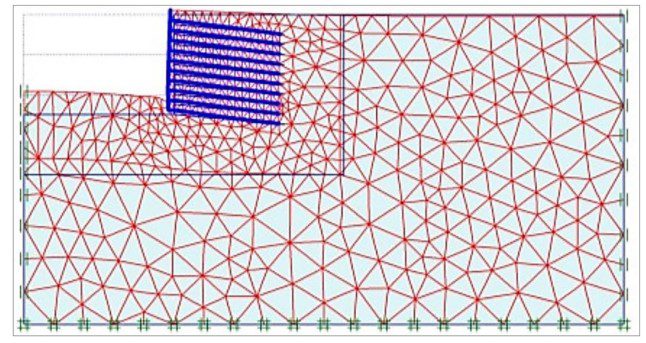
Geometry and Meshing Model
Over the past three decades, numerous numerical studies have modeled soil-nailing systems. Plaxis 2D, a finite element software, was used in this study.
Soil Nailing Procedure:
-
First, the excavation is carried out, and borehole depth is calculated using geotechnical analysis tools.
-
Then, nails are inserted into the boreholes.
-
Finally, shotcrete and other architectural components are applied to complete the stabilization process.
In Plaxis modeling, interaction between soil and structural nail elements is critical. Due to grout penetration and the formation of a tree-like matrix around the nail, the soil-nail interaction coefficient becomes significant. According to Plaxis guidelines, an interaction factor of 1 can be applied.