
Lateral Deformation of Shotcrete Facing at Failure Moment
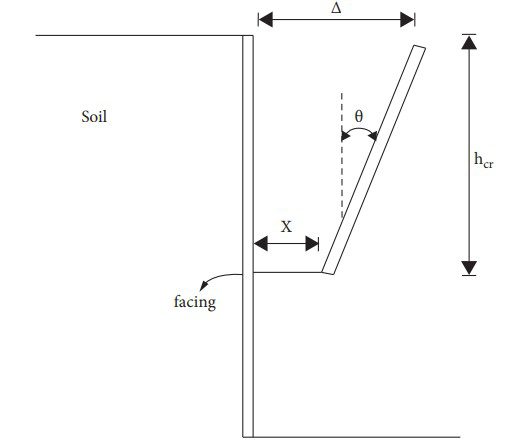
The deformation of the shotcrete facing just before failure involves a combination of translational, rotational, and bulging modes. (Figure 1 illustrates simplified forms of the translational and rotational modes). Increased surcharge leads to greater rotational movement of the facing, especially near the critical depth.
Progression of Displacement
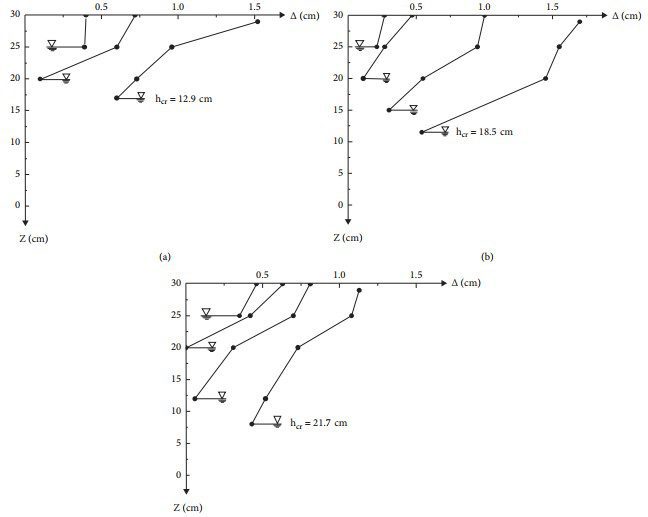
The evolution of lateral displacement from the start of excavation to the moment of facing failure is illustrated in Figure 2. It can be observed that as the excavation depth approaches the critical depth, the rate of lateral displacement increases significantly.
(Note: The critical depth refers to the water level depth at which facing failure occurs.)
In all models, the maximum and minimum displacements occurred at the top and bottom of the excavation, respectively. Halabian et al. identified three main deformation modes for nailed walls: translation, bulging, and rotation. For example, in horizontally nailed walls, the lateral displacement at the top is twice as large as that at the bottom.
Conditions Leading to Failure
In all three nailed models, a factor of safety below one was considered to ensure facing failure occurs before full water discharge from the membrane. As a result, the critical depths were different for each surcharge level:
-
12.9 cm for 100 kPa
-
18.5 cm for 70 kPa
-
21.7 cm for 40 kPa
This confirms that critical depth decreases with increasing surcharge.
Lateral Displacement vs. Surcharge
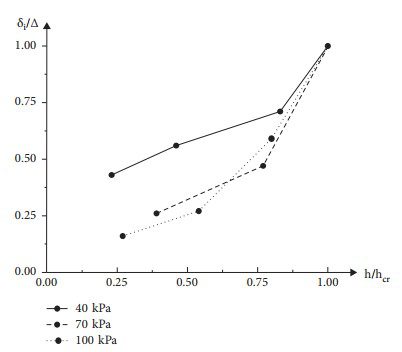
According to Figure 3, there’s a direct relationship between surcharge and the rate of lateral deformation: higher surcharge leads to greater displacements, especially near the critical depth.
Clouterre’s scaled wall models show similar trends in lateral deformation and surface settlement. However, the findings suggest that surcharge increases lateral displacement more significantly than settlement. For instance, in this study:
-
Under 40 kPa surcharge, lateral displacement was twice the settlement at the top of the wall.
-
Under 100 kPa, it was six times greater.
Thus, as surcharge increases, the ratio of lateral displacement to surface settlement also increases.
Figure Captions
-
Figure 1: Deformation modes of the facing
-
Figure 2: Progression of lateral displacement from start to failure (a) 100 kPa, (b) 70 kPa, (c) 40 kPa surcharge
-
Figure 3: Lateral displacement vs. h/hcr for different surcharge levels
