
Expansive Soil Stabilization for Infrastructure: Challenges and Innovations
Introduction to Expansive Soils
Naturally expansive soils are found in many regions worldwide. These soils experience significant volumetric changes due to seasonal moisture fluctuations, causing swelling and shrinkage that result in serious structural damage to buildings and infrastructure.
Examples of expansive clays include:
-
High-plasticity clays (high PI values)
-
Overconsolidated clays
-
Montmorillonite-rich soils
-
Weathered shales and schists
Studies have shown that damage from expansive soils, especially to light structures and roadway superstructures, can exceed that of natural disasters like floods and earthquakes. For instance, many roads built over expansive clay subgrades in eastern and central Texas have suffered from severe surface cracking and short service lives despite conservative design practices.
In some cases, maintenance costs have even exceeded initial construction costs. Surface failures have also been reported in embankment slopes, highway fills, and earth dams, highlighting the widespread impact of these soils.
The annual infrastructure damage costs due to expansive soils are estimated in the millions of dollars, prompting urgent research into more resilient and sustainable ground improvement techniques.
Advances in Expansive Soil Treatment
Many recent advancements in expansive soil stabilization have emerged, particularly chemical-based methods aimed at long-term resilience. This paper focuses on innovative stabilization approaches for civil and transportation infrastructure, specifically targeting the mitigation of surface slope failures induced by expansive soils.
Experimental Findings
Among the various stabilization techniques tested, the following combinations showed notable effectiveness:
-
8% lime + 0.15% fiber content
-
8% lime only
Both methods led to a 50–60% reduction in vertical deformation compared to untreated control samples, making them some of the most promising options for expansive soil treatment.
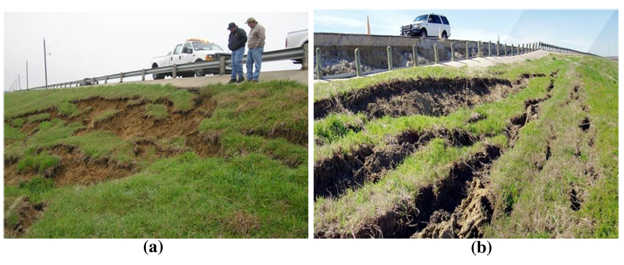
Figure 1:
Surface slope failures observed in (a) Grapevine Dam and (b) Joe Pool Lake Dam in Texas, USA
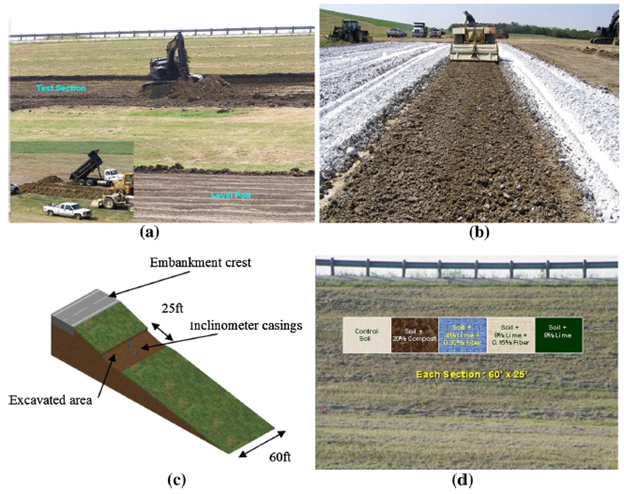
Figure 2:
Visuals showing (a) soil excavation, (b) lime stabilization process, (c) inclinometer casing installation, and (d) treated soil sections with lime and additive mixtures
