
The Importance of Retaining Structures in Deep Excavations and Their Impact on Adjacent Buildings
Introduction
Construction of buildings often involves deep excavation with nearly vertical walls, especially in urban environments. These excavation walls require temporary retaining systems to maintain slope stability and prevent damage to adjacent structures and underground utilities. The retaining structure plays a critical role in ensuring safety, controlling soil movement, and supporting project productivity.
In addition to its role in maintaining excavation stability, a well-designed retaining system directly influences the profitability, speed, and quality of the overall construction process. However, despite their importance, many engineers and contractors still lack sufficient knowledge in the correct design and execution of retaining structures and rely heavily on experience rather than standards or engineering analysis.
This article reviews the vital role of retaining systems in deep excavations and their effects on neighboring buildings.
Risks of Deep Excavation in Urban Areas
Past studies have shown that deep excavations in urban areas are associated with significant risks. Key findings include:
1. Groundwater Drawdown
Lowering the groundwater table during excavation can cause settlements and cracking in adjacent buildings, potentially leading to structural or non-structural damage.
2. Need for Precise Design
Accurate and context-specific design of the retaining system is essential, even for moderate excavation depths. The design should consider:
-
Heavy rainfall
-
Proximity of existing building foundations
-
Subsurface conditions
3. Preventive Measures
Construction near deep excavations must include preventive actions such as:
-
Pre-construction condition surveys of nearby buildings
-
Installation of inclinometers and piezometers
-
Real-time settlement and displacement monitoring
4. Risk Management
Risk management should include:
-
Hazard identification
-
Likelihood assessment
-
Consequence analysis
-
A well-defined action plan for mitigating risks
Performance and Benefits
Implementing an engineered retaining system in deep excavation projects:
-
Protects nearby structures and foundations
-
Prevents soil erosion and cave-ins
-
Reduces construction delays and legal claims
-
Enhances site safety and construction efficiency
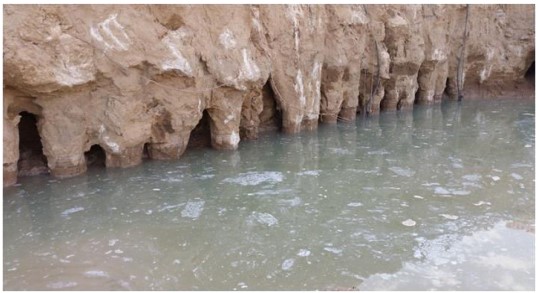
Figure 1:
Subsurface water has eroded the sandy layer and created voids and cavities behind the retaining piles.
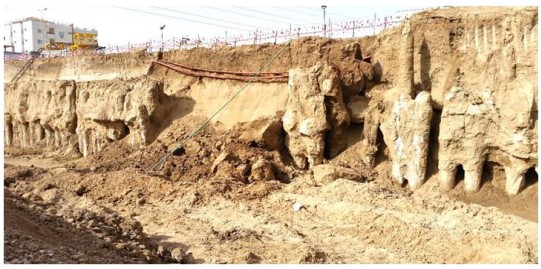
Figure 2:
Soil between the stabilization piles has collapsed, creating large cavities and failures along the excavation perimeter.
Conclusion
This study highlights the critical importance of retaining systems in deep excavations. Without proper design and implementation, nearby structures face serious risks, from minor settlement to catastrophic failure. By incorporating robust retaining structures, developers not only ensure safety but also improve the quality and efficiency of their construction projects.
