
Bond Strength Values in Soil Stabilization Design by Nailing Method
Introduction to Bond Strength in Soil Nailing
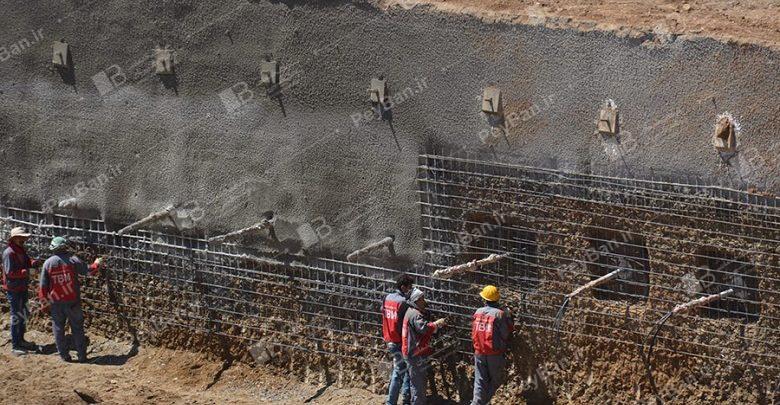
The pullout resistance of a nail installed using the drilling-grouting method depends on the nail size and the ultimate bond strength, qu. Bond strength is the shear resistance mobilized along the soil-grout interface. There is no standardized method to directly evaluate bond strength, so correlation studies and local experience play a key role.
Due to this local dependency, contract specifications typically require a percentage of installed nails (soil nails or reinforcing elements) to undergo in-situ pullout load tests to verify bond strength design.
Factors Influencing Bond Strength
Based on observations for drilled and grouted soil nails, bond strength depends on:
-
Surrounding soil conditions (type and characteristics)
-
Installation method, including:
-
Drilling process
-
Grouting procedure
-
Nature of grout
-
Grouting pressure (e.g., gravity or pressured)
-
Size of the grouted zone
-
For drilled and grouted nails in cohesionless soils, overburden pressure and soil grain characteristics affect the soil friction angle, which in turn influences bond strength. For fine-grained soils, bond strength is generally a fraction of the undrained shear strength, Su. The ratio qu/Su is higher in soft soils compared to stiff soils.
Typical Bond Strength Values by Soil Type and Construction Method
Table 1 presents typical ultimate bond strength values (qu) for drilled and grouted nails in various soils and with different installation methods. These values correspond primarily to gravity grouting.
These ranges represent conservative minimum and maximum values for specific soil types and construction methods. For example, for granular soils with wide ranges, the upper and lower bond strengths correspond to dense and loose soil conditions, respectively.
Local project-based testing (e.g., Pressuremeter Test – PMT) can estimate bond strength using the correlation:
qu=0.25×PL1.25qu = 0.25 \times PL^{1.25}
where PL is the pressuremeter limit pressure in MPa, and qu is in kPa.
For rocks, bond strength can be correlated with the unconfined compressive strength of intact rock. The Post-Tensioning Institute (PTI, 1996) suggests bond stress as approximately 10% of unconfined compressive strength, up to a maximum of 4000 kPa, but values should not exceed typical values shown in Table 1.
Effect of Grouting Pressure on Bond Strength
Bond strength can significantly increase with increased grout pressure. For soils under grout pressures less than 350 kPa, bond strength is roughly twice that of gravity grouting. For rocks, the increase can be even more pronounced but plateaus after a certain pressure. Therefore, in-situ load tests provide the most reliable bond strength estimate.
Shear Bond in Driven Soil Nails
In rare cases where driven nails are used in granular soils, bond strength is primarily frictional and influenced by:
-
Overburden pressure along the bond length
-
Relative soil density
-
Installation method
The apparent friction angle at the soil-nail interface can be estimated between 0.75 to 1 times the effective friction angle of the soil.
Table 1: Estimated Ultimate Bond Strength (qu) for Soil Nails and Reinforcements
| Material | Installation Method | Soil/Rock Type | Ultimate Bond Strength, qu (kPa) |
|---|---|---|---|
| Rock | Rotary drilling | Marl-Limestone | 300 – 400 |
| Phyllite | 100 – 300 | ||
| Chalk | 500 – 600 | ||
| Soft Dolomite | 400 – 600 | ||
| Fractured Dolomite | 600 – 1000 | ||
| Weathered Limestone | 200 – 300 | ||
| Weathered Shale | 100 – 150 | ||
| Weathered Schist | 100 – 175 | ||
| Basalt | 500 – 600 | ||
| Hard Shale or Slate | 300 – 400 | ||
| Cohesionless Soils | Rotary drilling | Sand or Gravel | 100 – 180 |
| Silty Sand | 100 – 150 | ||
| Silt | 60 – 75 | ||
| Piedmont Deposits | 40 – 120 | ||
| Soft Colluvium | 75 – 150 | ||
| Driven casing | Sand or Gravel (low overburden) | 190 – 240 | |
| Sand or Gravel (high overburden) | 280 – 430 | ||
| Dense Marine | 380 – 480 | ||
| Colluvium | 100 – 180 | ||
| Auger | Silty Sand Fill | 20 – 40 | |
| Soft Silty Sand | 55 – 90 | ||
| Silty Clayey Sand | 60 – 140 | ||
| Pressurized grouting | Sand | 380 | |
| Sand or Gravel | 700 | ||
| Fine-Grained Soils | Rotary drilling | Silty Clay | 35 – 50 |
| Driven casing | Silty Clay | 90 – 140 | |
| Auger | Loess | 25 – 75 | |
| Soft Clay | 20 – 30 | ||
| Stiff Clay | 40 – 60 | ||
| Stiff Silty Clay | 40 – 100 | ||
| Calcareous Clayey Sand | 90 – 140 |
