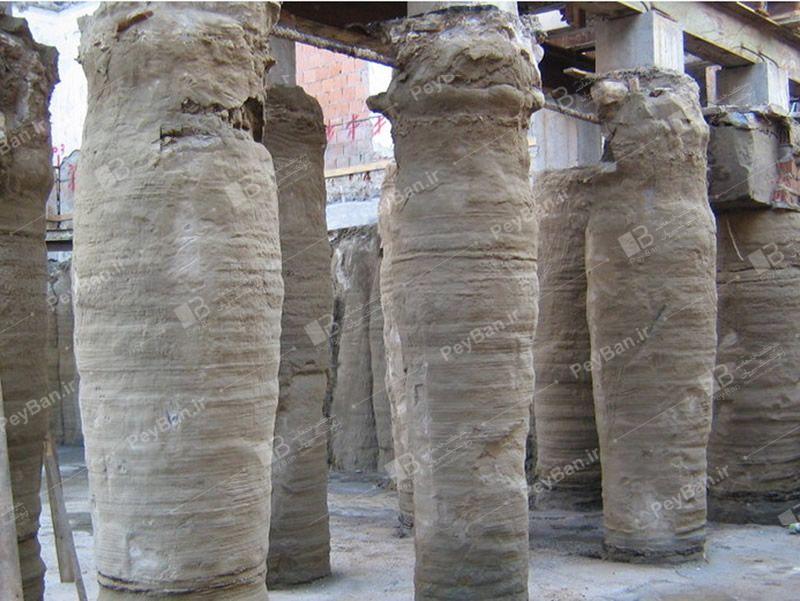
Factors Affecting the Jet Grouting Method
Several factors influence the efficiency of the jet grouting process and must be considered during the design, construction, and execution of high-pressure injection columns.
Effect of Dynamic Pressure
When the jet pressure exceeds the unconfined compressive strength of sandy and cohesive soils, the erosion range increases. Lower pressures can also achieve erosion ranges similar to higher pressures, but high pressure often saves time. Typically, for soils such as silt, sand, etc., injection pressure ranges from 30 to 60 MPa, and for rock, it exceeds 200 MPa.
Effect of Compressed Air
Increasing air velocity, even under low pressure, can significantly enhance erosion potential. Compressed air is crucial first for achieving maximum erosion energy and second for transporting debris and waste to the surface.
Effect of Soil
Soil type, ground layering, and nailing influence the quality of the soil–cement mix (produced from high-pressure injection) and the geometry of erosion. The turbulence caused by fluid injection alone is sufficient to disrupt the grading of non-cohesive soils. As plasticity and stiffness increase, erodibility decreases to the point where jet grouting alone cannot effectively erode stiff cohesive soils.
Gravel, boulders, and cobbles, although classified as non-cohesive soils, may or may not be easily erodible depending on density, soil structure, and other conditions. When soil contains more than 30% gravel or when gravel size exceeds 10 cm (cobbles), the resulting soil–cement diameter may be smaller than predicted. Reducing the rotation speed of mixing tools or increasing grout pump velocity may solve these issues.
Other Influential Factors in Jet Grouting
The quality of the nozzle’s inner surface, its materials, and its dimensions are critical. Even a good nozzle can be easily damaged before use, causing irregularities in jet and fluid flow. To address this, nozzle conditions must be inspected before and after each high-pressure injection. These inspections use a special measurement system, including dynamic testing with pressure-sensitive films.