
Top-Down Excavation Support
Role of Floor Slabs in Top-Down Excavation Support Method
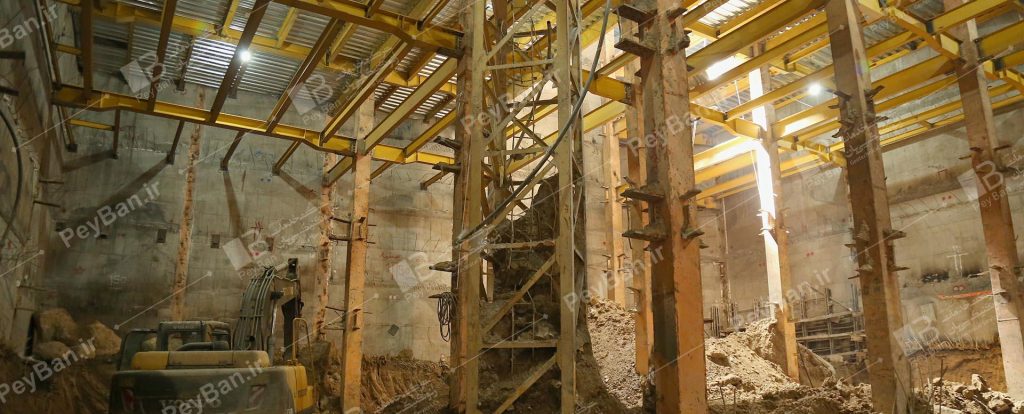
In top-down excavation support, the floor slab acts as a substitute for temporary struts. Due to its high stiffness, it significantly reduces deformation of surrounding ground and adjacent structures. Hence, this method is typically used in deep excavations requiring strong support systems.
Forces on Struts in Top-Down Excavation
In this method, forces in the struts—based on the average undrained shear strength—are close to those predicted by Peck’s lateral pressure diagram. Struts near corners of excavations experience lower forces, indicating the corners play a critical role in reducing strut loading.
Displacements in Walls and Surrounding Soil
Significant internal displacements occur within both the wall and adjacent soil, diminishing with horizontal distance from the wall. The maximum wall displacement is near the excavation surface, typically 51–57% of the excavation depth, excluding early excavation stages.
Bending Moments in Walls
Measured bending moments (from strain gauges on reinforcement) are lower than those inferred from inclinometers as depth increases. This is likely due to cracking in concrete walls, a factor that should be considered in structural design and deformation prediction.
Lateral Earth Pressure
Lateral earth pressure near the surface (within 12 m) increases with excavation depth due to inward wall movement. At deeper levels, pressure drops below Rankine’s theoretical values, possibly due to neglecting wall-soil friction in the theory.
Ground Settlement
The greatest surface settlement occurs at 0.63–0.78 times the excavation depth, where lateral pressure peaks. This value remains consistent across different depths and matches well with Clough and O’Rourke’s studies.
Pore Water Pressure Behind the Wall
Pore pressure outside the excavation drops considerably—except near the wall and surface—due to unloading effects. Although it initially drops during excavation, it increases over time, aligning with ongoing wall displacement and ground settlement.
References:
-
Kung, G.T.C. (2009). Comparison of excavation-induced wall deflection using top–down and bottom–up construction methods in Taipei silty clay. Computers and Geotechnics, 36(3), 373–385.
-
Cotton, D.M., & Luak, R.D. (2010). Recent advances in the top–down construction of a 26.4-meter deep soil nail retention system. Earth Retention Conference, 208, 375–381.
