
Vibratory Compaction for Soil Improvement and Liquefaction Mitigation
Application of Vibratory Compaction in Ground Improvement
Vibratory compaction is a widely used deep ground improvement method applied to both cohesive and non-cohesive soils to reduce the potential for earthquake-induced liquefaction. The evaluation and quality control of soil improvement through vibratory compaction is a critical task during field implementation, particularly for liquefaction mitigation.
Importance of In-Situ Testing
Generally, both in-situ and laboratory tests are employed to evaluate the effects of ground improvement. However, laboratory test accuracy is highly influenced by sample disturbance, and obtaining high-quality undisturbed samples from non-cohesive soils is challenging and costly in routine construction projects. Consequently, in-situ tests remain the dominant approach in geotechnical engineering for assessing ground improvement effectiveness.
Use of Cone Penetration Testing (CPT, CPTU, and SCPTU)
Among in-situ testing methods, the Cone Penetration Test (CPT) is widely used to assess soil improvement and determine the achieved improvement level. The piezocone test (CPTU), an advanced version of CPT, is a preferred tool for evaluating the quality of ground improvement due to its ability to provide continuous soil profiling.
CPTU simultaneously measures key parameters such as cone tip resistance, sleeve friction, and pore water pressure. Recently, shear wave velocity measurements—directly correlated with soil density and stiffness—have gained increasing attention.
Shear wave velocity is also closely related to the cyclic resistance ratio (CRR), a critical factor in simplified liquefaction potential assessments. As a result, seismic piezocone testing (SCPTU) has become increasingly popular for monitoring and evaluating the effects of soil improvement.
Study Objective and Key Parameters
This study analyzes the changes in CPT-based parameters before and after ground improvement, including:
-
Soil density index
-
Soil electrical resistance
-
Shear wave velocity
-
Earth pressure coefficient
-
Cone tip resistance

Figure 1:
Variation of excess pore water pressure over time and distance from the vibration point at depths of (a) 5 meters and (b) 8 meters
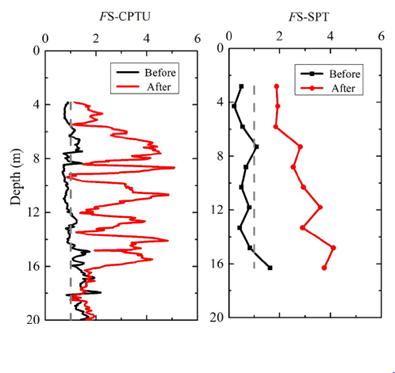
Figure 2:
Liquefaction assessment results before and after vibratory compaction ground improvement
Let me know if you’d like the figures captioned differently or formatted for a report or website.
