
Effect of Installation on Long-Term Cyclic Behavior of Piles in Sand: A Numerical Study
Introduction
Accurate prediction of long-term deformations of pile foundations under severe cyclic loading is a crucial challenge in geotechnical engineering. This issue is particularly significant for the foundations of offshore wind turbines, which are subjected to millions of load cycles over their service life. While various numerical studies have explored the cyclic behavior of piles, most have overlooked the influence of pile installation methods on long-term performance.
This study investigates the impact of installation effects using two different methods—driven (impact) and non-driven (cast-in-place) piles—through an Eulerian-Lagrangian approach coupled with a hypoplastic material model. Both fully drained and partially drained soil conditions were considered. The pile response was analyzed under severe cyclic loading exceeding five million cycles using a high-cycle accumulation model.
Key Findings
1. Influence of Initial Soil Density
-
In medium-dense sand, modeling the installation process reduced permanent deformations for cast-in-place piles.
-
In contrast, in initially dense sands, the installation effect increased deformation due to overestimation of mobilized stiffness.
2. Decreasing Installation Effects Over Time
-
As the number of load cycles increased, the differences in response due to installation diminished.
-
This was attributed to the redistribution of effective stresses and density stabilization around the pile.
3. Load Direction Sensitivity
-
Vertically loaded piles were more affected by the installation process than laterally loaded piles.
-
The stress path and strain localization patterns vary significantly depending on the type of pile loading.
4. Under- and Overestimation Risks
-
In medium-dense sand, ignoring installation can lead to overestimation of long-term deformations.
-
Conversely, in dense sand, the installation effects might be underestimated, causing false confidence in performance predictions.
Practical Implications
This study highlights the necessity of including pile installation effects in long-term cyclic loading analyses. Ignoring these factors could lead to inaccurate deformation predictions, particularly in medium-dense sands, potentially compromising foundation safety and serviceability for offshore and infrastructure projects.
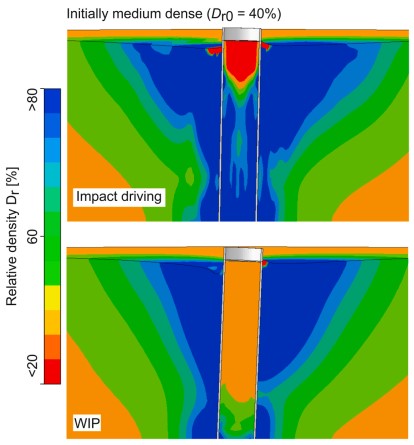
Figure 1:
Field relative density distribution after five million cyclic loads for driven vs. cast-in-place piles.
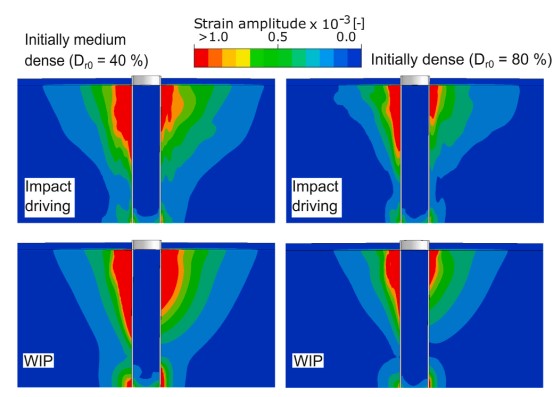
Figure 2:
Strain amplitude fields for driven and cast-in-place piles under different initial soil densities.
