
Seismic Protection of Geotechnical Structures Using EPS-Sand Mixtures
Challenges in Earthquake Damage Prevention
Preventing earthquake-induced damage and preserving the service life of dams, embankments, bridges, and other geotechnical structures is a major challenge in geotechnical engineering. Numerous soil improvement techniques have been proposed to minimize seismic damage and protect structures from seismic motion.
Limitations of Conventional Seismic Isolation Techniques
Base isolation systems and seismic dampers are commonly used to enhance seismic performance, particularly in sandy soils. However, due to their high cost and the need for extensive laboratory and field experience, these systems are not widely adopted in civil engineering projects. Therefore, there is a growing need for cost-effective and simple isolation methods.
Use of Lightweight Compressible Materials
One promising approach involves using lightweight compressible materials between the soil and geotechnical structures. In recent years, several studies have explored the use of lightweight fill materials such as rubber particles and expanded polystyrene (EPS) geofoam as seismic isolation systems.
Laboratory Evaluation of EPS-Sand Dynamic Properties
In this study, a series of cyclic strain-controlled triaxial tests and bender element tests were conducted to evaluate the dynamic characteristics of saturated sand mixed with varying proportions of EPS under small shear strain conditions. The effects of different parameters—such as shear strain amplitude, confining pressure (25, 50, and 100 kPa), and EPS content (up to 2% by weight)—on small-strain shear modulus, secant shear modulus, and damping ratio were investigated.
Key Experimental Findings
Laboratory results showed that the shear wave velocity and maximum shear modulus obtained from bender element tests decrease as EPS content increases. The tests also revealed that both damping ratio and shear modulus are significantly influenced by the EPS content. In fact, increasing the EPS content led to damping ratio increases of up to 100% or more under constant confining pressure.
On the other hand, at all confining pressure levels, the shear modulus of the EPS-sand mixtures experienced a sharp decrease with increasing EPS content. It was also concluded that confining pressure plays a crucial role in both damping ratio and shear modulus of the mixtures.
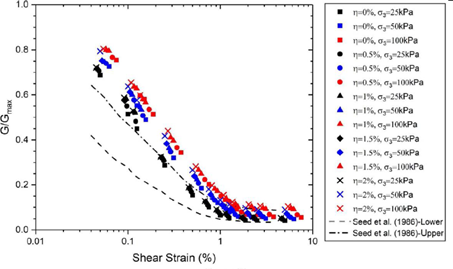
Figure 1:
Shear modulus graph of EPS-sand mixtures compared with upper and lower bound curves in the literature
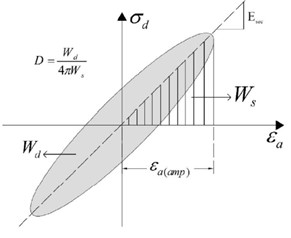
Figure 2:
Typical stress-strain hysteresis loop diagram
