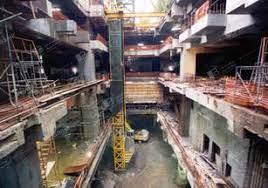
Disadvantages and Challenges of the Top-Down Construction Method
The Top-Down (TD) method is widely used for large and complex construction projects, especially in densely populated urban areas. While this method offers key advantages, such as speeding up the construction of upper floors before completing underground excavation, it also comes with significant challenges that must be carefully managed. Some of the main disadvantages and challenges include:
1. Difficulty in Excavation Beneath the Slab
Excavating and soil removal underneath the concrete slab is one of the most critical challenges of the Top-Down method. Limited working space, poor lighting, and inadequate ventilation make it very difficult and stressful for workers. Moreover, the excavation equipment often struggles to access these confined spaces, reducing work speed and increasing operational costs.
2. Encountering Unforeseen Subsurface Conditions
Unexpected underground obstacles such as buried foundations, large boulders, or hard soil layers can delay excavation and force major revisions in project planning. These situations often require redesign and use of specialized equipment, leading to increased costs and time overruns.
3. Slower Earthworks Compared to Conventional Methods
In Top-Down construction, excavation proceeds only after each slab is cast, which slows down the overall earthwork process compared to traditional open excavation methods. This results in extended project durations.
4. Necessity of Precise Coordination Among Construction Teams
The Top-Down method demands highly coordinated efforts between project managers, site workers, and logistics teams. Every stage — from material delivery to storage and transfer — must be meticulously planned. Any disruption in this coordination can cause significant project delays.
5. Challenges in Concrete Pouring and Slab Strength
Another critical issue is the timing of excavation under recently poured slabs. Excavation cannot start immediately after concrete placement, as premature soil removal may cause unwanted settlements and compromise structural stability. According to Roli and Yarwood (1988), pile-supported foundations are considered the most suitable for this method.
6. Limitations on Foundation and Column Types
The method imposes restrictions on the choice of foundation and column systems in the basement levels. Since columns and foundations must be aligned with slab construction sequences, selecting appropriate foundation types becomes a key engineering decision.
Proposed Solutions to Improve Efficiency
-
Enlarging Openings in Slabs: Increasing slab opening sizes allows dedicated pathways for material movement inside and outside the building, improving workflow and reducing delays.
-
Accurate Planning and Use of Modern Technologies: Employing advanced technologies such as Building Information Modeling (BIM) and automated excavation machinery can significantly enhance accuracy and speed.
Successful Case Study: IFC Tower, Hong Kong
A notable example of effective Top-Down implementation is the International Finance Centre (IFC) Tower in Hong Kong — a mixed-use hotel and commercial complex near Hong Kong’s harbor. Construction began in 1997 and completed in 2003. Due to spatial limitations and the need to expedite upper floor construction, the Top-Down method was applied successfully, demonstrating optimal use of this technique in a major urban project.