
Disadvantages and Challenges of the Top-Down Construction Method
The increasing population, limited urban space, and high cost of land acquisition have pushed developers toward building taller structures and adding underground levels to accommodate shared spaces. Various excavation and construction methods are available, generally categorized into bottom-up methods (e.g., soil nailing, bracing, anchorage) and top-down construction techniques. The Top-Down method is a modern approach in the construction industry that has gained popularity due to its ability to reduce project timelines, allow simultaneous above- and below-ground construction, and eliminate the need for neighbor consent.
Despite its advantages, this method comes with several disadvantages and challenges that can make its execution more complex and costly. In this article, we explore the key downsides of top-down construction and the challenges it poses in civil engineering projects. Project owners, managers, and designers must weigh the pros and cons of each excavation method and match them with the project’s specific conditions to make the best decision.
1. Project Management Complexity
One of the most significant challenges of top-down construction is complex project management. Because construction activities occur simultaneously above and below ground, precise coordination between engineering and execution teams is crucial. Any lack of synchronization may lead to scheduling delays and increased project costs.
Another challenge is the need for highly skilled personnel. Due to the technical intricacies and necessity for detailed planning, experienced engineers and specialists are vital. Without such expertise, the project may suffer from delays and serious cost overruns.
Scheduling issues are also common. Delays in one part of the project can affect the entire timeline due to the interdependence of construction phases.
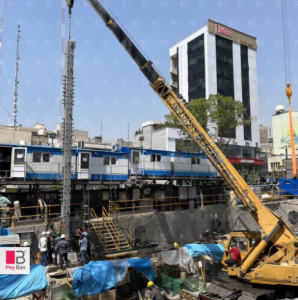
Figure 1 illustrates the density of machinery, workers, and active work fronts typical of such projects.
2. High Initial Costs
One of the main disadvantages of the top-down method is its high initial cost. This stems from:
-
The use of specialized equipment and skilled labor
-
Simultaneous execution of structural elements above and below ground
-
Early installation of load-bearing components like piles, columns, and retaining walls
-
Complications in deep excavation of basement levels
Much of the cost goes toward advanced machinery capable of operating in constrained spaces. These requirements drive up overall project expenses.
Additionally, training and hiring skilled workers further increases costs. Labor must be specially trained and experienced in top-down construction techniques.
However, in many cases, the time savings and enhanced safety offered by this method compensate for the higher upfront investment.
3. Spatial and Operational Constraints
Geotechnical conditions and soil composition significantly influence the choice of construction method. On unstable ground or weak soil, top-down construction poses greater challenges. These areas often require extra stabilization, which can extend project duration and increase costs — another notable drawback of this technique.
4. Technical and Execution Difficulties
The top-down approach demands high technical precision. Any mistake during construction or excavation can lead to serious structural issues. This means that constant communication and coordination between engineering and execution teams is essential.
5. Execution Risks
Due to its complexity, top-down construction carries significant execution risks. Errors during construction phases can result in major damage.
One major risk involves maintaining structural stability — especially in projects with large and heavy buildings. Ensuring structural integrity is crucial and demands advanced monitoring.
Simultaneous excavation and construction also introduce safety hazards for workers. Any failure in personal protective equipment (PPE) or human error may result in severe accidents.
6. Design Limitations
The top-down method comes with certain design constraints. Since the upper structure must remain stable during excavation, there is less flexibility in architectural design.
For instance, in projects that require mid-project design changes, implementing those changes can be difficult and expensive. This often reduces design creativity and limits structural variety.
7. Not Suitable for All Projects
While top-down construction is ideal for large, complex projects with deep basements, it is not suitable for all scenarios.
In smaller projects or shallow excavations, top-down construction may be inefficient and costly. In such cases, traditional excavation methods may be more practical. Studies show that for depths up to around 8 meters, bottom-up methods are more economical than top-down techniques — although each project must be assessed individually based on its specific conditions.
It’s worth noting that this doesn’t mean top-down is inherently disadvantageous — rather, it is best suited to specific types of projects with the right conditions.
Conclusion
The top-down construction method is a cutting-edge technique that offers major advantages, including shorter project timelines and higher efficiency. However, it also presents significant challenges such as project management complexity, high initial costs, technical constraints, and execution risks.
Therefore, a thorough assessment of the project’s needs and conditions is essential before choosing this method. By doing so, project stakeholders can ensure alignment between construction methodology and project goals — leading to successful and cost-effective results
