
Jet Grouting for Diaphragm Wall Displacement Control in Deep Urban Excavations
Overview of Jet Grouting in Soil Improvement
Jet grouting is a highly advanced and effective soil improvement method that can significantly limit diaphragm wall displacement, particularly in deep excavations. In urban areas like Taiwan, deep excavations often take place in densely built environments, making proximity to adjacent structures a critical concern. Despite precision in construction practices, excavation invariably leads to ground settlement, which can cause structural and non-structural damage to neighboring buildings.
Urban Construction Challenges in Taiwan
Field experience in Taiwan reveals that notable ground settlements occur near construction sites, often extending up to three to four times the excavation depth. This indicates that buildings within this zone are highly likely to be affected, increasing the risk of legal claims and financial liabilities. For engineers and contractors, preserving the integrity of adjacent structures becomes a priority during excavation planning and execution.
Case Study: 22.3-Meter Deep Excavation with Six Basement Levels
This study examines the design and implementation of a soil improvement strategy aimed at reducing diaphragm wall movement in a 22.3-meter deep excavation with six underground floors. Inclinometers were installed to evaluate field performance during excavation.
Jet Grouting Implementation
In this project, jet grouting was applied to improve passive soil resistance along the excavation boundary. The technique involves injecting high-pressure grout to create grouted soil columns, enhancing the soil’s mechanical properties.
-
The overall improvement in soil resistance was estimated using a weighted average method.
-
Field monitoring showed that jet grouting was highly effective, significantly reducing diaphragm wall movement.
Numerical and Economic Analysis
A back-analysis using numerical simulation confirmed the effectiveness of partial jet grouting, showing that this method can reduce wall displacement by over 40%.
Key Takeaways:
-
Partial soil improvement is more cost-effective than full-area treatment.
-
Strategic placement of jet grouting zones can achieve substantial deformation control with lower implementation costs.
-
Without jet grouting, diaphragm wall displacements would have been approximately 40% higher, based on engineering judgment and available data.
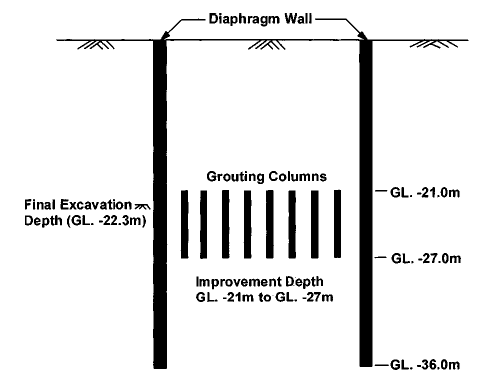
Figure 1:
Schematic illustration of jet grouting soil improvement for MR residential building
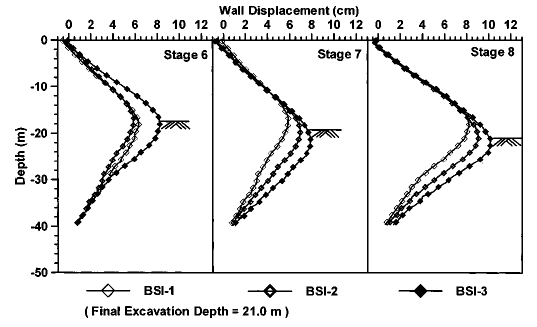
Figure 2:
Displacement chart of the diaphragm wall based on project monitoring lines
