Structural Deformation Adjacent to Deep Excavations
Introduction
With rapid urbanization in large metropolitan areas, more residential and commercial buildings are being constructed adjacent to existing structures. A significant number of investments are directed toward building multi-level underground parking near newly developed or existing metro lines, offering unprecedented future transportation opportunities.
New structures often require deep excavations ranging from 25 to 30 meters, typically with large plan dimensions. One of the critical aspects of designing deep excavations is evaluating their impact on the surrounding soil and adjacent structures.
Objectives and Scope
This study investigates the concerns related to ground movements and deformations of nearby structures caused by deep excavations. Four case studies of excavations in Quaternary alluvial soils near existing tunnels and metro stations were analyzed, with special attention given to in-situ measurements of vertical deformation in metro infrastructures.
Observations and Findings
-
Deformations of adjacent structures—including Earth Pressure Balance (EPB) tunnels, Tunnel Boring Machine (TBM) tunnels with segmental lining, and metro stations—are discussed based on their relative positions to the excavation site.
-
Common deformation ranges due to excavation are provided as functions of depth, distance from the wall, and structure type.
-
An empirical equation was developed to estimate vertical deformation of TBM tunnels near excavation sites.
-
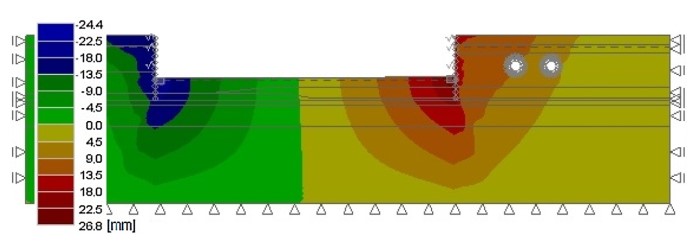
A 2D finite element model was performed for one of the described cases and its findings are detailed.
Geotechnical and Structural Behavior
TBM Tunnel Deformation Patterns
-
TBM tunnels protected by segmental linings, located 20–40 meters from the excavation wall at or above the final excavation depth, may experience up to 10 mm of vertical settlement.
-
TBM tunnels below the final excavation depth, within the same distance, are minimally affected, typically experiencing only 1 mm of movement.
Considerations for Metro Stations and Structures
While no universal conclusion can be made from limited case studies, several design recommendations can be proposed:
-
Metro stations should be constructed within deep diaphragm walls.
-
Diaphragm walls should extend at least 10 meters below the foundation level of the metro station.
-
Diaphragm walls must be supported by permanent or temporary underground slabs.
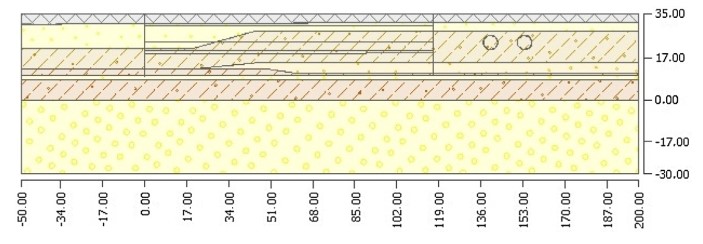
Figure 1: Schematic of the geotechnical conditions used in the numerical modeling