
Erosion-Based System in Excavation Support
The jet grouting method for soil improvement in excavation support (retaining structures, nailing, anchoring, micropiles, top-down, etc.) is effective across a wide range of soil types. It is an erosion-based system: granular soils are more erodible, while high-plasticity clays erode less.
In this method, the in-situ soil is mixed with a cementitious grout. Hydraulic rotary drills reach the design depth, where grout—and sometimes air and water—are injected. The result is a cemented structure called soilcrete.
Types of Jet Grouting Systems:
1. Single-Fluid System
High-pressure cement grout alone is used to erode and mix the soil. It is most effective in low-cohesion soils.
2. Double-Fluid System
A high-pressure cement grout jet is surrounded by an air jet. The added air enhances erosion and is more effective in cohesive soils found in excavation support.
3. Triple-Fluid System
A high-pressure water jet surrounded by air is used to erode the soil. Below that, cement grout is injected at lower pressure. This separation of erosion and injection improves soilcrete quality and is the most effective system for cohesive soils in excavation support.
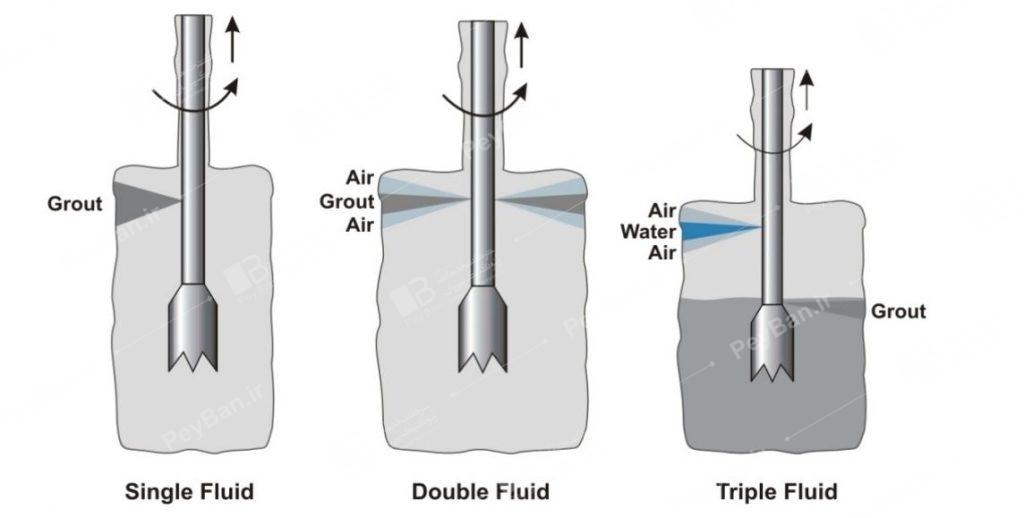
Image: Triple-fluid jet grouting system in action
